
Table of Contents
- The Minimalist Skincare Philosophy: Why Less Is More in 2026
- Essential Morning Routine Steps for a Dermatologist Recommended Skincare Routine
- Effective Nighttime Repair Protocols: Overnight Recovery for Skin Health
- Morning vs Evening Skincare Routine: Key Differences and Timing
- How to Layer Skincare Products Correctly for Maximum Absorption
- Skincare Routine for Beginners: Start Simple, Stay Consistent
- Budget-Friendly vs. Luxury Equivalents: Building Your Dermatologist Recommended Skincare Routine on Any Budget
- Frequently Asked Questions
Last Updated: September 19, 2026
The Minimalist Skincare Philosophy: Why Less Is More in 2026
A dermatologist recommended skincare routine 2026 is a short, consistent set of products built around four jobs: gentle cleansing, antioxidant protection, sunscreen, and overnight repair. Most dermatologists favor fewer products used daily over crowded shelves of occasional ones.
Essential Morning Routine Steps for a Dermatologist Recommended Skincare Routine
Morning skincare has one priority: defend the skin before the day starts. A dermatologist recommended skincare routine for daytime stays brief, usually three steps, because layering too many actives in the morning raises irritation risk without adding much benefit.
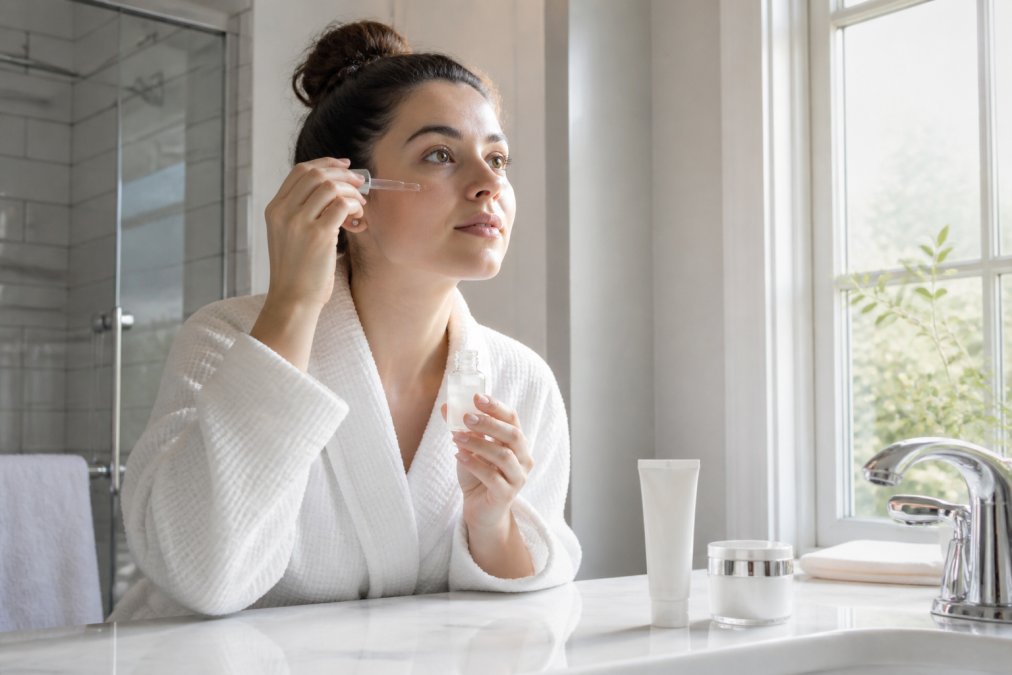
Gentle Cleansing and Antioxidant Protection
Start with a gentle cleanser, not a stripping one. Many people with oily or combination skin over-wash in the morning, damaging the barrier and triggering more oil production. A mild, non-comedogenic cleanser removes overnight buildup without that rebound. If skin feels tight after cleansing, the cleanser is too strong, tightness is a signal, not a clean feeling.
- Concentration: Most research-backed formulas sit between 10% and 20% L-ascorbic acid. Below 8% the effect is minimal; above 20% irritation rises faster than benefit.
- Form: L-ascorbic acid is the most studied form but is unstable and oxidizes quickly. Derivatives like sodium ascorbyl phosphate and tetrahexyldecyl ascorbate are more stable and gentler, though the evidence behind them is thinner. For sensitive skin, a derivative at a higher percentage often beats L-ascorbic acid at a lower one.
- Packaging: Vitamin C degrades with light and air. An opaque, airless pump or a dark glass bottle with a dropper preserves potency far better than a clear jar.
Daily Application of Sunscreen: The Non-Negotiable Step
Sunscreen is the single most important product in any routine. Photoaging, cumulative UV damage, causes most visible aging, including fine lines, uneven texture, and dark spots. No serum or retinoid comes close.
- Quantity: The SPF number on the label assumes about a nickel-sized amount for the face and neck, roughly a quarter teaspoon. Most people apply a third of that, which drops real-world protection well below the labeled figure.
- Reapplication: SPF breaks down with UV exposure, sweat, and time. For extended outdoor days, reapply every two hours. Indoors near windows, a single morning application is usually sufficient.
- Type: Mineral filters (zinc oxide, titanium dioxide) sit on the surface and suit reactive or post-procedure skin. Chemical filters tend to be more cosmetically elegant and easier to apply in the full quantity needed. Neither is inherently safer, the best one is the one you will actually use generously.
Effective Nighttime Repair Protocols: Overnight Recovery for Skin Health
Night is when skin repairs itself, so evening routines carry the stronger actives. A dermatologist recommended skincare routine splits intensity this way: protection in the morning, correction at night.
Retinoids and Peptides for Collagen Production
Retinoids remain the most dermatologist-backed ingredient for collagen production and skin texture, speeding cell turnover and softening fine lines over months. The trade-off is real: dryness, peeling, and sensitivity in the first few weeks.
Morning vs Evening Skincare Routine: Key Differences and Timing
The difference between morning and evening routines is purpose, not product count. Mornings defend: antioxidants and sunscreen. Evenings repair: cleansing, retinoids, and richer moisturizer.
| Routine | Primary Goal | Core Steps | Key Ingredients |
|---|---|---|---|
| Morning | Protect | Cleanse, treat, moisturize, SPF | Vitamin C, sunscreen |
| Evening | Repair | Double cleanse, treat, moisturize | Retinoid, peptides |
| Weekly | Maintain | Exfoliate once or twice | AHA or BHA |
How to Layer Skincare Products Correctly for Maximum Absorption
The rule for how to layer skincare products correctly is simple: thinnest texture first, thickest last. Water-based serums go before creams, and sunscreen always goes last in the morning.
A practical order looks like this:
- Cleanser
- Toner or essence, if you use one
- Water-based serum, such as vitamin C or peptides
- Treatment, such as a retinoid at night
- Moisturizer
- Sunscreen, mornings only
Skincare Routine for Beginners: Start Simple, Stay Consistent
A skincare routine for beginners should have three products, not ten. Cleanser, moisturizer, and sunscreen cover the basics; add a serum and a retinoid once those are habits. What separates a routine that survives past week three is not the product list, it is the order you add things and how you adjust for your skin type.
The Four-Week Onboarding Sequence
Stacking new products all at once makes it impossible to tell what is working and what is irritating. A staged approach solves that:
- Weeks 1-2: Gentle cleanser, moisturizer, and morning sunscreen only. No actives. This establishes the barrier baseline and reveals how your skin behaves without interference.
- Week 3: Add one antioxidant serum in the morning, applied to dry skin before moisturizer. If no reaction after seven days, keep it.
- Week 4 onward: Add a retinoid at night, starting two nights per week. Build to every other night over four to six weeks before attempting nightly use.
Skin Type Customization Matrix
Generic advice fails because oily, dry, and sensitive skin need different versions of the same four steps. Use this matrix to adjust the capsule routine rather than rebuild it:
| Skin Type | Morning Focus | Evening Focus | Watch Out For |
|---|---|---|---|
| Dry | Cream cleanser, rich moisturizer, hydrating SPF | Peptides, occlusive cream, retinoid buffered over moisturizer | Foaming cleansers, alcohol-based toners |
| Oily | Gel cleanser, lightweight gel SPF | Retinoid, gel moisturizer, salicylic acid 1-2x weekly | Heavy oils, thick creams, over-cleansing |
| Combination | Gentle cleanser, SPF | Retinoid on oily zones (T-zone), richer cream on cheeks | One-size-fits-all products applied uniformly |
| Sensitive | Rinse or milk cleanser, mineral SPF | Barrier cream, low-strength retinoid (start 0.01-0.025%) | Fragrance, essential oils, strong acids |
Adjusting Your Routine After Professional Treatments
One scenario most beginner guides skip: what to do after a dermatologist-performed procedure. After a chemical peel, laser session, or microneedling, your normal routine needs a temporary reset.
- Days 1-3 post-procedure: Cleanser (or just water), a plain barrier moisturizer, and mineral sunscreen. No actives, no exfoliation, no retinoids.
- Days 4-10: Reintroduce a gentle antioxidant if the skin is no longer raw. Continue avoiding retinoids and acids.
- Week 2 onward: Reintroduce retinoids at half your previous frequency and strength, and only after your practitioner confirms the barrier has recovered.
Budget-Friendly vs. Luxury Equivalents: Building Your Dermatologist Recommended Skincare Routine on Any Budget
Price and results are only loosely connected in skincare. The actives dermatologists actually recommend, sunscreen filters, vitamin C, retinoids, appear in affordable formulas as often as expensive ones.
Frequently Asked Questions
What is the best skin care routine for 2026?
A dermatologist recommended skincare routine for 2026 focuses on a minimalist, capsule approach: gentle cleansing, antioxidant protection with vitamin C, and daily sunscreen in the morning; then cleanser, a retinoid or peptide serum, and moisturizer at night. This routine supports skin barrier repair and collagen production without overwhelming your skin with unnecessary products.
What is the #1 dermatologist recommended skin care?
Sunscreen is the most frequently recommended product by dermatologists. Daily application of a broad-spectrum SPF 30 or higher protects against photoaging and supports overall skin health. It is the foundation of any preventative care routine, regardless of skin type or age.
What are the skincare trends for 2026?
Key trends for 2026 include the minimalist skincare routine, multi-functional products that combine active ingredients, and a focus on the skin barrier. Consumers are moving toward formulas with peptides, growth factors, and antioxidants, while also seeking sustainable ingredient sourcing and budget-friendly options.
How do I build a dermatologist-approved skincare routine?
Start with a gentle cleanser, a moisturizer suited to your skin type, and a broad-spectrum sunscreen. Introduce one active ingredient at a time, such as vitamin C in the morning or a retinoid at night, to see how your skin responds. This step-by-step approach helps you build a routine that supports skin health without irritation.
What ingredients should I prioritize in my 2026 skincare routine?
Prioritize sunscreen, antioxidants like vitamin C, retinoids, peptides, and growth factors. These ingredients address photoaging, collagen production, and skin texture. Also look for non-comedogenic and hydrating formulas to maintain the skin barrier. A minimalist routine with these key actives is more effective than a crowded shelf of products.
Can I use a minimalist skincare routine if I have sensitive skin?
Yes, a minimalist routine is often ideal for sensitive skin. Focus on gentle cleansing, a fragrance-free moisturizer, and mineral sunscreen. Introduce active ingredients slowly and patch-test new products. A dermatologist recommended skincare routine for sensitive skin typically avoids harsh exfoliants and emphasizes barrier repair.