
Table of Contents
- Understanding Active Ingredients in Science-Backed Skincare
- How to Read Skincare Ingredient Labels for Evidence-Based Efficacy
- Identifying Skincare Ingredients with Peer-Reviewed Research
- How to Verify Skincare Claims and Distinguish Marketing from Science
- The Role of Clinical Trials and Dermatological Authority
- Clean Beauty vs. Science-Backed: Understanding the Real Difference
- Formulation Science: Stability, Bioavailability, and Delivery Systems
- Practical Steps to Build Your Science-Backed Routine
- Frequently Asked Questions
Last Updated: September 21, 2026
Understanding Active Ingredients in Science-Backed Skincare
Science-backed skincare relies on active ingredients that have clinical evidence supporting their effectiveness. An active ingredient is a component in a skincare product that produces a measurable change in your skin through a proven mechanism of action. These differ from inactive ingredients, which provide texture, stability, or delivery but don't directly affect skin cells.
The distinction matters because marketing claims often blur this line. A product might contain a beneficial ingredient at a concentration too low to work. Understanding which actives have peer-reviewed research behind them is the foundation of identifying truly science-backed skincare.
The most credible active ingredients have multiple published studies showing consistent results. Retinoids, peptides, and antioxidants are the gold standard because dermatologists recommend them routinely and researchers have documented their effects on skin physiology over decades.
How to Read Skincare Ingredient Labels for Evidence-Based Efficacy
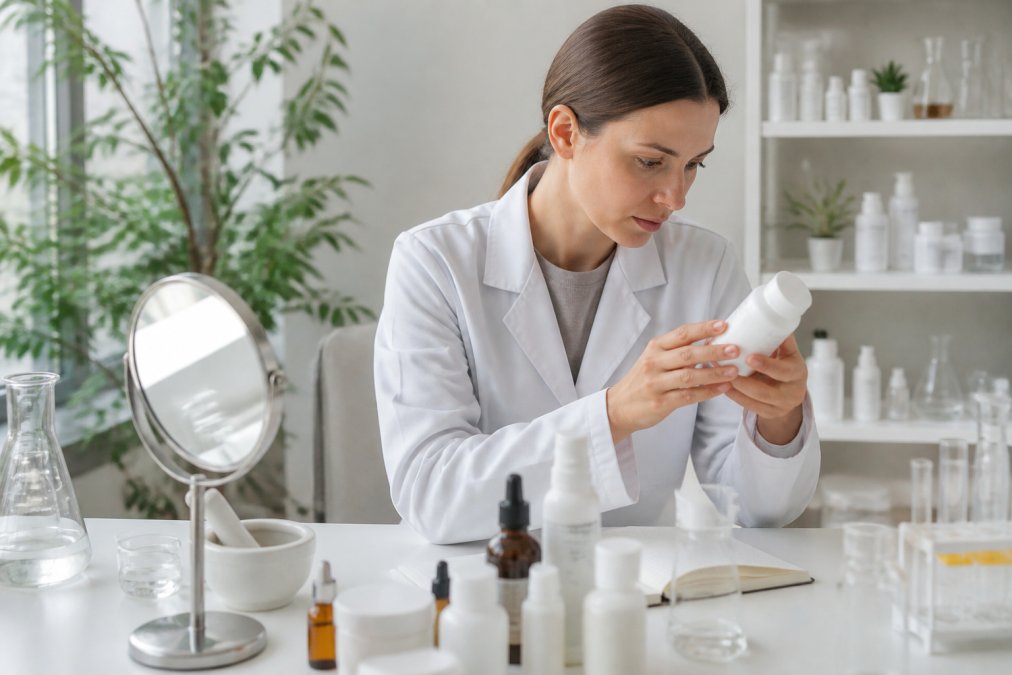
Ingredient labels list components in descending order by weight. The first five ingredients make up the bulk of the formula. If an active ingredient appears near the end of the list, its concentration is likely too low to deliver results.
Look for three critical details on any skincare label:
- The active ingredient name (INCI name, not marketing name)
- Its position in the ingredient list (higher = more concentrated)
- The percentage concentration (if disclosed, many brands don't)
Effective concentrations vary by ingredient. Glycolic acid needs 7-10% to exfoliate. Niacinamide works at 4-5%. Retinol requires 0.25-1%. A product listing an active but placing it after fragrance or silicones likely won't deliver visible results.

Many brands hide active concentrations behind vague language like "proprietary blend" or "complex." Some brands disclose percentages to help consumers understand exactly what they’re using. This transparency signals confidence in their formulation.
Identifying Skincare Ingredients with Peer-Reviewed Research
Not every ingredient with a study behind it is equally supported. One small study from a brand's own lab carries less weight than multiple independent studies published in dermatological journals. Peer-reviewed research means other scientists have reviewed the methodology and confirmed the findings are legitimate.
The most reliable research comes from clinical trials where participants use a product for 4-12 weeks while scientists measure objective changes. Skin hydration, elasticity, wrinkle depth, and pigmentation can all be measured with instruments, not just observer opinion.
When evaluating research credibility, consider these markers:
- Multiple independent studies (not just one funded by the brand)
- Published in dermatology journals (not marketing materials)
- Human subjects tested for 4+ weeks (not lab-only or animal studies)
- Measurable outcomes (wrinkle depth reduced by X%, not "skin looked better")
- Peer review process documented (you can find the journal and article)
Brands citing peer-reviewed research will link to PubMed or the journal directly. If a company claims research but won't share the study, that's a red flag. Legitimate science-backed skincare has nothing to hide.
Retinoids: The Gold Standard for Cell Turnover
Retinoids are vitamin A derivatives that increase cell turnover and collagen synthesis. They're the most researched anti-aging actives in skincare. Decades of clinical trials show retinoids reduce fine lines, improve texture, and fade hyperpigmentation.
Retinoid strength varies significantly:
- Retinol (weakest, over-the-counter)
- Retinaldehyde (intermediate strength)
- Prescription retinoids (tretinoin, adapalene, strongest)
Even weak retinoids require patience. Results take 8-12 weeks of consistent use. Many people experience irritation in the first weeks, which is normal as skin adjusts. Starting low and building tolerance prevents barrier damage.
The mechanism is well-documented: retinoids bind to skin cell receptors and signal cells to divide faster, shedding dead skin and revealing smoother texture underneath. This process also stimulates fibroblasts to produce more collagen, addressing deeper wrinkles.
Peptides and Collagen Synthesis
Peptides are short chains of amino acids that signal skin cells to produce more collagen. They work through a different mechanism than retinoids but complement them well. Research shows peptides improve skin firmness and reduce fine line appearance over 4-8 weeks.
The evidence for peptides is solid but newer than retinoid research. Multiple clinical trials confirm their efficacy, but they work more subtly than actives like acids or retinoids. Many dermatologists recommend peptides for sensitive skin because they're gentler than exfoliants.
Peptide concentration matters. Products listing peptides near the end of the ingredient list won't deliver noticeable results. Effective formulas place peptides in the top ingredients.
Antioxidants and Oxidative Stress Protection
Antioxidants neutralize free radicals that damage skin cells and accelerate aging. Vitamin C, vitamin E, ferulic acid, and resveratrol are well-researched antioxidants with proven benefits. They protect skin from environmental damage and support collagen integrity.
Vitamin C is the most studied antioxidant for skincare.
How to Verify Skincare Claims and Distinguish Marketing from Science
Here's how to separate marketing hype from actual science:
Marketing claim: "Clinically proven to reduce wrinkles" What to look for: Link to the actual study, sample size (ideally 30+ people), duration (4+ weeks), and specific measurement (wrinkle depth reduced by X%)
Brands using science-backed skincare will provide:
- Specific ingredient names and concentrations
- Links to published research (not just marketing studies)
- Clear mechanisms of action (how the ingredient works)
- Realistic timelines (results in 4-12 weeks, not overnight)
- Honest limitations (what the product won't do)
The Role of Clinical Trials and Dermatological Authority
Clinical trials are the gold standard for skincare efficacy. A properly designed trial measures objective skin changes in real people using the product for a set period. Results are then analyzed statistically and published for peer review.
Clean Beauty vs. Science-Backed: Understanding the Real Difference
Clean beauty emphasizes natural or non-toxic ingredients. Science-backed skincare prioritizes clinical evidence of efficacy. These two approaches often conflict.
Formulation Science: Stability, Bioavailability, and Delivery Systems
An effective active ingredient can fail if the formulation doesn't preserve it or deliver it to skin cells. Formulation science determines whether an active actually reaches your skin in a form it can use.
Practical Steps to Build Your Science-Backed Routine
Start with a simple routine addressing your primary concern. Overcomplicating your regimen makes it hard to identify which products actually work and increases irritation risk.
Step 1: Identify your skin type and primary concern
- Oily, combination, dry, or sensitive?
- Main issue: aging, acne, hyperpigmentation, or sensitivity?
Step 2: Choose one active ingredient to start
- Beginners: start with a gentle exfoliant like glycolic acid or a basic retinol
- Sensitive skin: peptides or hydrating actives like hyaluronic acid
- Anti-aging focus: retinoids or peptides
Step 3: Use correct concentrations

- Glycolic acid: 7-10% for exfoliation (like The Ordinary Glycolic Acid 7% Exfoliating Toner, Brightening and Smoothing Daily Toner for More Even-Looking Skin Tone)
- Niacinamide: 4-5% for oil control and barrier support (like The Ordinary Niacinamide 10% + Zinc 1%, 30ml)
- Azelaic acid: 10% for uneven tone and sensitivity (like The Ordinary Azelaic Acid Suspension 10%, Formula for Uneven and Blemish-Prone Skin)
Step 4: Wait 4-8 weeks before assessing results

Step 6: Always use sunscreen during the day
| Step | Timeline | Key Action |
|---|---|---|
| Identify skin type | Week 1 | Determine your primary concern |
| Choose one active | Week 1 | Pick an ingredient matching your concern |
| Verify concentration | Week 1-2 | Check label for effective percentages |
| Use consistently | Weeks 2-8 | Apply 4-5 times weekly, build tolerance |
| Assess results | Week 8 | Evaluate skin changes objectively |
| Add second active | Week 9+ | Only after tolerating the first |
Frequently Asked Questions
What makes a skincare product science-backed?
Science-backed skincare is formulated with active ingredients that have undergone clinical trials and peer-reviewed research demonstrating efficacy. Look for products listing specific ingredient concentrations, mentioning dermatological testing, and referencing clinical validation. Brands that cite actual studies, not just general claims, and use evidence-based ingredients like retinoids, peptides, or hyaluronic acid at therapeutic levels are more likely to deliver real results than products relying on marketing hype alone.
How do I verify skincare claims on a product label?
Check the ingredient list for active compounds with documented research, verify ingredient concentration (listed in descending order by weight), and review any available information about how the product was tested or evaluated. Search PubMed or Google Scholar for peer-reviewed studies on the specific ingredients. Be skeptical of vague terms like 'natural' or 'advanced formula', science-backed products specify exactly what's in them and why. Avoid products making disease claims or using only testimonials instead of clinical data.
Which skincare ingredients have the strongest peer-reviewed research?
Retinoids (vitamin A derivatives) have the most extensive clinical evidence for reducing fine lines and improving skin texture. Hyaluronic acid, peptides, and niacinamide are well-documented for hydration and barrier support. Glycolic acid and azelaic acid show strong evidence for exfoliation and addressing uneven tone. Antioxidants like vitamin C support collagen synthesis and protect against oxidative stress. The Ordinary's Hyaluronic Acid 2% + B5 with Ceramides, Glycolic Acid 7% Toner, and Niacinamide 10% + Zinc 1% feature these well-known active ingredients at clearly stated concentrations.
What are common red flags in skincare marketing?
Watch for vague claims ('improves skin' without specifics), absence of ingredient concentrations, no mention of clinical testing, overuse of buzzwords like 'natural' or 'clean' without scientific backing, and testimonials replacing actual data. Claims about 'microbiome balancing' or 'cellular regeneration' without supporting studies are red flags. Avoid products that avoid listing ingredients or hide concentrations. Legitimate science-backed brands clearly state what's in their products, at what percentage, and cite the research proving efficacy.
Building a science-backed skincare routine means moving beyond marketing claims to focus on clinical evidence, ingredient concentration, and formulation quality. S&Y company helps you feel confident in your skincare choices by curating products with proven active ingredients at effective concentrations. Start with one evidence-based active, use it consistently for 8 weeks, and let the research guide your decisions. Your skin will reflect the science you choose.