


Last Updated: November 2, 2026
Quick Summary
To safely introduce retinol, start with a low concentration in a cream base once a week, then build to two to three times a week and every other night over roughly eight weeks. Apply a pea-sized amount to clean, completely dry skin at night, follow with moisturizer, and use sunscreen every morning.
- Pick a low concentration in a cream or lotion base rather than a serum or high-strength treatment.
- Apply a pea-sized amount to the whole face and neck, avoiding eyelids, nostrils, and lips.
- Wait two to five minutes after patting dry, since damp skin increases absorption and stinging.
- Use the retinol sandwich method, moisturizer then retinol then moisturizer, for your first few applications.
- Pause retinol at the first sign of burning, persistent redness, or flaking that does not settle within a day.
Table of Contents
- Why Retinol Needs a Careful Start
- Choosing a Beginner Retinol Strength and Formula
- A Week-by-Week Schedule for How Often to Use Retinol
- How to Apply Retinol: Cleanse, Dry, Thin Layer
- Retinol and Moisturizer Order: Buffering and the Sandwich Method
- Retinol and Sunscreen: Why Morning Protection Is Non-Negotiable
- Pregnancy, Prescriptions, and Actives That Clash
- What to Do When Irritation Hits
- Frequently Asked Questions
Why Retinol Needs a Careful Start
Retinol is one of the most studied ingredients in skincare, but it punishes enthusiasm.
The evidence base is real.
The core idea: **you are not trying to get retinol into your skin as fast as possible.
If you are building an anti-aging routine from scratch, our skincare routine for aging skin guide covers the full sequence around retinol.
Choosing a Beginner Retinol Strength and Formula
For a first retinol, pick a low concentration in a cream or lotion base, not a serum or high-strength treatment.
Concentration is only half the story; the other half is delivery.
Buying the strongest option for value is a mistake.
Check these before you buy:
- Concentration: low end of the range, clearly printed
- Base: cream or lotion over thin serums
- Packaging: opaque, airtight pump or tube, since retinol degrades in light and air
Our Collagen & Retinol Toner Pads offer a ready-to-use pad format with collagen, retinol, hyaluronic acid, centella, and niacinamide.
A Week-by-Week Schedule for How Often to Use Retinol
How often to use retinol at the start: once a week, then two to three times a week, then every other night, over roughly eight weeks. Skipping straight to nightly use is the single most common reason people quit retinol.
Below is the schedule we would give a friend. Adjust it if your skin reacts, not because you feel impatient.
| Phase | Frequency | What to Expect | Move On When |
|---|---|---|---|
| Weeks 1-2 | Once weekly | Mild tingling, possible light flaking | No redness after 48 hours |
| Weeks 3-4 | Two to three times a week | Skin settles between applications | No stinging on non-retinol nights |
| Weeks 5-8 | Every other night | Tolerance builds steadily | Skin feels normal the morning after |
| Week 9+ | Nightly, if you want | Maintenance | Only if every-other-night is comfortable |
Weeks 1-2: Once Weekly
Apply on one fixed night, such as Sunday. One night gives your skin six days to recover and shows you how it responds. Expect some tingling. That is normal. Burning that lasts more than a few minutes is not.
Weeks 3-4: Two to Three Times a Week
If the first two weeks passed without lasting redness, add a second night, then a third, keeping at least one rest day between applications. This spacing builds tolerance without overwhelming the barrier.
Weeks 5-8: Building to Every Other Night
Increase frequency gradually. Every other night is the sweet spot for most people, and many stay there permanently. There is no prize for nightly use if every-other-night keeps your skin calm.
How to Apply Retinol: Cleanse, Dry, Thin Layer
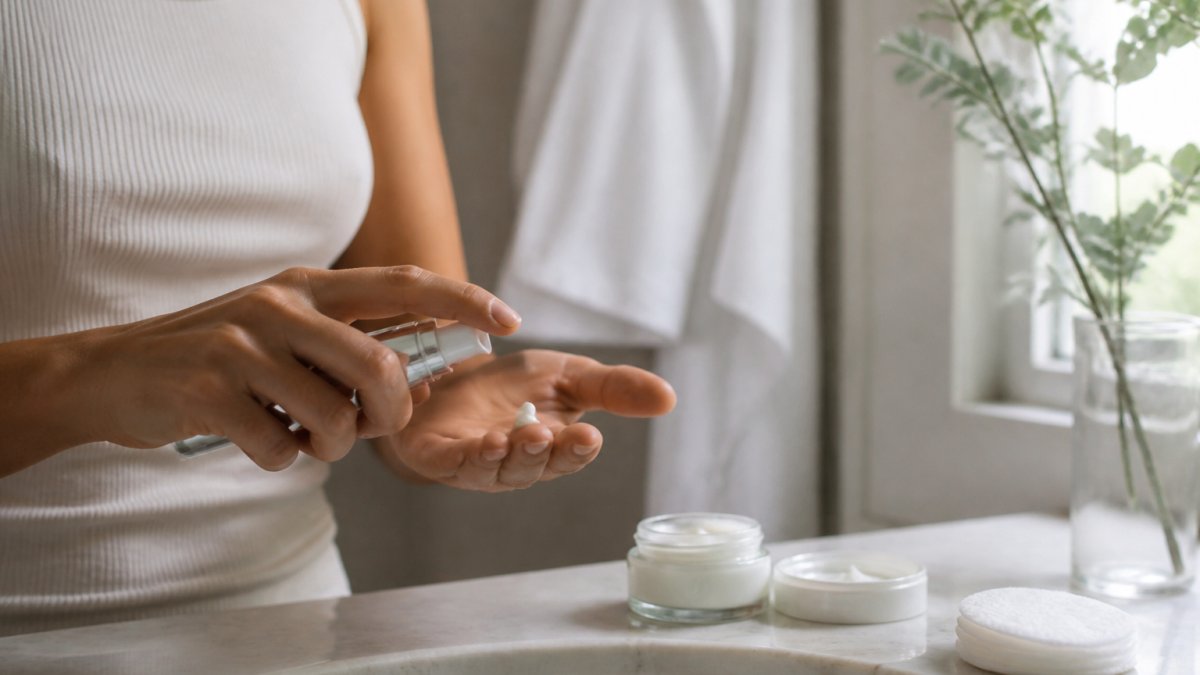
Apply retinol to clean, completely dry skin in a thin layer at night, then follow with moisturizer. Most retinol irritation starts with an application mistake, not the product itself.
Why dry skin matters
Water increases skin permeability. On damp skin, more active crosses the barrier at once, which is why a product that felt fine on dry skin can sting on slightly damp skin. Wait until your face feels fully dry, typically two to five minutes after patting dry.
The correct amount
A pea-sized amount covers the whole face and neck. More product means more peeling, redness, and a longer recovery, not better results. One pump is usually enough. With a pad format, follow the package instructions and do not press hard or scrub.
Step-by-step application
- Cleanse with lukewarm water and a gentle, non-stripping formula; hot water and harsh cleansers raise irritation risk.
- Pat dry and wait until skin is fully dry to the touch.
- Apply a pea-sized amount to forehead, cheeks, nose, and chin, spreading thinly. Avoid eyelids, immediate eye area, nostrils, and lips.
- Wait a few minutes to let the product settle and reduce pilling.
- Apply moisturizer over the top to seal in hydration and buffer the active.
- Wash your hands, and keep the tube or pump closed and away from direct light.
Application mistakes that cause most irritation
- Using too much product. A pea-sized amount is the ceiling, not the starting point.
- Applying to damp skin. Wait the extra two minutes.
- Skipping the moisturizer step. The top layer is part of the routine, not optional.
What about the neck and hands?
The neck and backs of the hands are common sites for aging signs and often skipped. They can tolerate retinol, but start them later than your face, once your face has adjusted, using the same thin layer and buffering approach.
A note on timing
Retinol belongs in the evening because sunlight degrades it and skin repairs overnight. You do not need to change your morning routine beyond sunscreen. If you double cleanse at night, apply retinol after the second cleanse and after your skin has dried.
Retinol and Moisturizer Order: Buffering and the Sandwich Method
Retinol goes before moisturizer in a standard routine; moisturizer seals it in and reduces water loss. If your skin is sensitive, you flip part of that order using buffering: moisturizer first, then retinol, then moisturizer again.
Buffering slightly reduces how much retinol reaches the skin: a little strength for a lot more comfort, which for a beginner is usually the right deal.
What the Retinol Sandwich Method Looks Like
The retinol sandwich method is simple: moisturizer, then retinol, then moisturizer again. The first layer cushions the active.
Do this on your first few applications, or any time your skin feels tight.
Collagen & Retinol Toner Pads – 90 Count →
Once your skin tolerates plain retinol, drop the bottom layer and keep the top one. That is the normal progression.
Retinol and Sunscreen: Why Morning Protection Is Non-Negotiable
Retinol and sunscreen belong together, every single day.
The good news: retinol does not make skin photosensitive forever.
So the rule is short. Retinol at night, sunscreen every morning, reapplied if you are outside for long stretches.
If you use retinol in the evening and skip morning sunscreen, you are fighting your own results.
Pregnancy, Prescriptions, and Actives That Clash
Do not use retinol during pregnancy or while breastfeeding, and check with a doctor before starting if you are trying to conceive.
The same caution applies to prescription retinoids.
Some actives clash with retinol in the same routine:
- Strong acids: glycolic, salicylic, and lactic acid used the same night can push irritation too far
- Benzoyl peroxide: can destabilize retinol and irritate skin
- Vitamin C: fine for most people, but use it in the morning and retinol at night to keep both stable
A workable approach is to alternate nights rather than layer products. Acids one night, retinol the next.
If you have a skin condition or you are on any prescription treatment, ask a dermatologist before adding retinol.
What to Do When Irritation Hits
Pause retinol at the first sign of real irritation, meaning burning, persistent redness, or flaking that does not settle within a day. Pausing is not failure.
A Stanford dermatologist has publicly questioned whether retinol deserves its hype in every case, which is a useful reminder: Stanford Medicine's discussion of retinol makes the point that popularity is not the same as suitability.
Step 1: Stop all actives, not just retinol
For three to five nights, stop every active: retinol, exfoliating acids, vitamin C, benzoyl peroxide, and any prescription topical. The goal is to remove everything that asks your skin to do work so the barrier can repair. Keep only three products: a gentle cleanser, a moisturizer, and sunscreen.
Step 2: Repair the barrier with the right products
Barrier repair is about adding the right products, not more of them. A redness-soothing serum is one option to help calm the skin. Look for gentle moisturizers without fragrance or drying alcohols during recovery. Apply moisturizer twice daily, thicker at night. If even a plain moisturizer stings, the barrier is compromised and you should extend the rest period.
Step 3: Know the signs that warrant a clinician
Most retinol irritation settles with rest and moisturizer. See a dermatologist if you have:
- Blistering, oozing, or crusting
- Swelling around the eyes, lips, or face
- A rash that spreads beyond the application area
If you have a skin condition such as eczema, rosacea, or psoriasis, or you are on a prescription treatment, ask a dermatologist before restarting.
Step 4: Restart with clear criteria
Do not restart because you feel impatient. Restart when your skin meets these criteria:
- No redness or stinging when you apply a plain moisturizer
- No flaking for at least three consecutive days
- Skin feels normal in the morning without a heavy occlusive layer
When you meet those criteria, restart at once weekly, not at the frequency you were using before. Buffer every application for the first two weeks back: moisturizer, then retinol, then moisturizer. If irritation returns, drop back to the previous step and hold there for two weeks before trying again.
Step 5: Adjust the product, not just the pace
If you have followed the schedule, buffered correctly, and still react on every attempt, the product may be the problem rather than the pace.
Watch out: returning to nightly use too soon after irritation is the most common reason people end up quitting retinol entirely. The restart is where discipline matters most.
Frequently Asked Questions
How often should beginners use retinol?
Start with one application per week for the first two weeks, then move to two or three nights a week if your skin feels calm. After roughly a month of no redness, dryness, or flaking, you can build toward every other night. Daily use is a goal for later, not a starting point. If stinging or peeling appears, drop back to the previous frequency for a week before trying again.
Should you apply retinol before or after moisturizer?
Either order works, but the sequence changes the strength of the dose. Applying retinol to clean, dry skin and following with moisturizer gives the fullest effect. Applying moisturizer first, waiting a few minutes, then retinol softens the delivery, which suits sensitive or combination skin. This is the retinol and moisturizer order question most dermatologists get, and the answer depends on how reactive your skin is.
Can you use retinol while pregnant or breastfeeding?
Topical retinoids are generally avoided during pregnancy and breastfeeding, and this is a conversation to have with your doctor rather than a decision to make from an article. If you are pregnant, trying to conceive, or nursing, ask your clinician before starting any retinol product. Many people pause retinol entirely during this period and rely on sunscreen, moisturizer, and gentle cleansing instead.
How long does it take for skin to adjust to retinol?
Most people see the worst of the dryness and flaking in the first two to four weeks, with tolerance building over eight to twelve weeks of consistent, gradual use. Visible smoothing and tone improvements usually take longer, often three to six months. Speeding up the schedule does not speed up results; it usually triggers a setback that costs you more time than patience would have.
Introducing retinol safely comes down to patience: a low strength, a slow schedule, and a moisturizer you trust. That is the whole method, and it works because it respects how skin actually adapts. S&Y company curates skincare essentials for exactly this kind of steady routine, from a gentle cleanser to a soothing serum for the days your skin needs a break. Get started with S&Y company and build a retinol routine your skin can actually keep up with.
